
If this is your first trip to China, go to Beijing and Shanghai. See the Great Wall, walk the Bund, don’t overthink it. But if you’ve already done that — if the Forbidden City and the Terracotta Warriors are checked off and you’re planning trip number two, three, or four — the itinerary should look completely different.
These ten cities rarely make a first-timer’s list, and that’s exactly the point. None of them are secret, exactly. But none of them are crowded with the kind of tour groups that make the headline sites feel more like theme parks than places. Here’s where to go next.
1. Pingyao, Shanxi
The only ancient walled city in China preserved entirely without modern construction inside its walls — no glass towers poking up behind the rooftops, no retrofitted concrete. Pingyao was one of the country’s banking capitals in the Qing dynasty; China’s first modern draft bank opened here in 1823. Walk the 6-kilometer city wall at dusk and you’re looking at essentially the same skyline merchants saw 150 years ago.
2. Datong, Shanxi
An old coal town most travelers skip entirely, which is a mistake. The Yungang Grottoes — over 50,000 Buddhist statues carved into a sandstone cliff face starting in the 5th century — rival anything at the better-known Longmen or Mogao caves, with a fraction of the visitors. Pair it with the Hanging Temple, built into a cliffside outside the city, and you have one of the most visually dramatic days in northern China.
3. Kaifeng, Henan
Capital of China seven times over across different dynasties, now most famous locally for its night market rather than its palaces. Kaifeng’s real appeal is how unpolished it still is — layers of history stacked under a modern city that hasn’t been rebuilt for tourism the way Xi’an has. Come hungry; the street food here is some of the best in the country.
4. Quanzhou, Fujian
Once the largest port in East Asia, where an estimated 3,000 ships a year loaded silk, tea, and porcelain bound for the Middle East and beyond. UNESCO recognized it in 2021 as the “Emporium of the World in Song-Yuan China.” A mosque, a Buddhist temple, and a Taoist temple sit within walking distance of each other — a physical record of just how many trading cultures passed through. One detail worth noting: the porcelain that shipped out of Quanzhou’s harbor a thousand years ago was largely Dehua ware, a different tradition from what you’ll find further inland in Jingdezhen, but part of the same story of Chinese ceramics reaching the rest of the world.
5. Chaozhou, Guangdong
Overshadowed by Shenzhen and Guangzhou, a couple of hours away by high-speed train, Chaozhou is where Chaoshan cuisine actually comes from — the beef hotpot, the oyster omelets, the tea culture built around tiny cups of gongfu-style oolong. The old town is walkable, lived-in, and largely untouched by the scale of development that’s transformed most of the Pearl River Delta.
6. Jianshui, Yunnan
Most Yunnan itineraries stop at Dali and Lijiang, both worth visiting but both firmly on the tour bus circuit now. Jianshui is quieter: a Confucian temple that’s one of the largest in China outside Beijing, a well-preserved old town, and a still-working tradition of purple clay pottery that gets a fraction of the attention Jingdezhen’s porcelain does.
7. Kaili & Zhenyuan, Guizhou
Guizhou is where you go for ethnic minority culture that hasn’t been fully packaged for tourism yet — Miao and Dong villages, terraced rice fields, and festivals that run on a lunar calendar rather than a tour schedule. Kaili is the practical base; Zhenyuan, built along a river bend with Ming-era architecture, is the more photogenic overnight stop.
8. Wuyuan, Jiangxi
Rural rather than urban, and worth a special mention if you’re already routing through this part of China: Wuyuan sits between Huangshan and Jingdezhen, and its blend of terraced canola fields and Huizhou-style villages makes it one of the most photographed rural landscapes in the country every spring. (If you’re combining Huangshan and Jingdezhen on the same trip, see our guide to connecting the two — Wuyuan fits naturally in between.)
9. Nanjing, Jiangsu
Capital of China under six different dynasties, including the early Ming, yet consistently overshadowed by Beijing and Xi’an when people think “imperial history.” The Ming city wall is the longest surviving city wall in the world, and the Purple Mountain mausoleums get a fraction of the crowds that line up at the Terracotta Warriors. An underrated city for anyone who actually wants to read the plaques.
10. Jingdezhen, Jiangxi
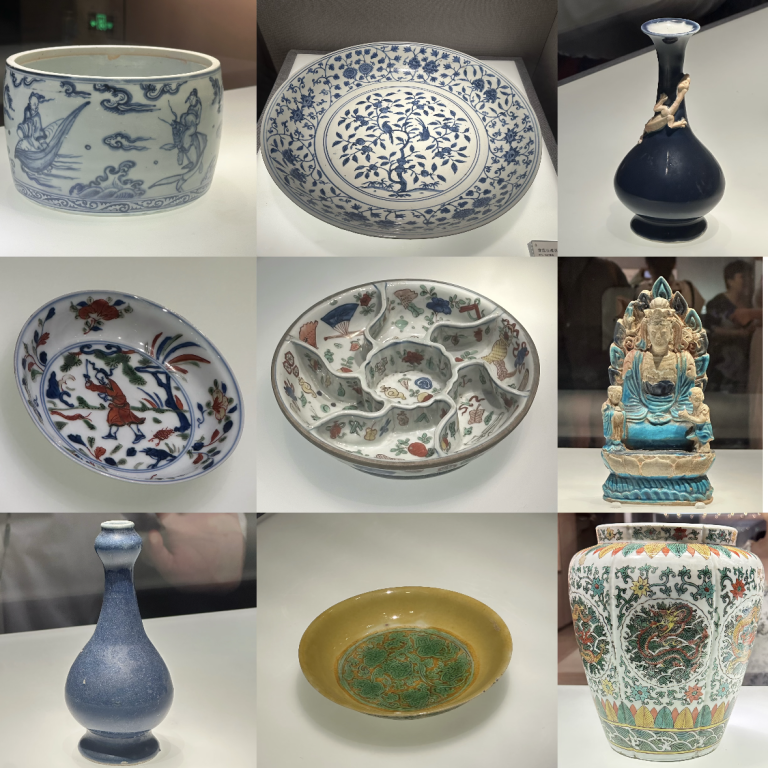
We’re not neutral on this one, so take it as the local’s pick rather than an outside opinion: Jingdezhen was inscribed as a UNESCO World Heritage Site in July 2026, the first porcelain-related site ever to receive the designation, and it still isn’t on most travelers’ radar. A thousand years of continuous porcelain production, still happening in working studios rather than behind museum glass. You can watch a kiln fire, sit at a wheel yourself, and walk through a night market where ceramics students sell their own work off cardboard boxes.
Of everywhere on this list, it’s also the easiest to add onto an existing itinerary — under an hour from Huangshan by high-speed train, a few hours from Shanghai. If you want the honest case for visiting, we’ve made it in detail in Is Jingdezhen Worth Visiting? And if the language barrier or logistics of a lesser-visited city give you pause, that’s precisely what a private, English-speaking guide solves — see our Full-Day Guided Experience for what that actually looks like on the ground.
How to Actually Use This List
Don’t try to hit all ten in one trip. Pick a region and go deep: Shanxi (Pingyao + Datong) makes a tight, efficient loop; Jiangxi (Wuyuan + Jingdezhen, extended to Huangshan in Anhui) makes another. Guizhou and Yunnan pair well if you have more time and want to go further off the main rail lines. The common thread across all ten is the same: these are places that reward slowing down, not places built for a checklist.
Have a Question About This Trip?
Send us a quick note and we will get back to you.