
Pick up any cup in Jingdezhen and turn it over. Most of the time there is a small blue stamp on the bottom, and most of the time it says some version of “Jingdezhen”. Visitors often take that stamp as proof that the piece was made here. Sometimes it is. Sometimes it only means someone in Jingdezhen bought a box of stamps.
We live here. Lucas grew up on Shuguang Road, which is now one long street of tableware shops, and we spend a lot of our week turning cups over in markets and studios. This guide explains what the marks you will see actually say, which one is protected by law, how to read old export marks, and why a mark on its own is never the whole answer.
The Short Answer
- 景德镇制 (Jingdezhen zhi) means “made in Jingdezhen”. It is the mark you want to see, but on its own it is a claim, not a certificate.
- The round seal with “1004” and “MADE IN JINGDEZHEN” is the city’s official regional brand mark, launched in 2022. Only companies licensed by the Jingdezhen Ceramics Association may use it, and since May 2024 a local law protects it.
- Older marks (a square seal-script stamp, or the three characters 景德镇 written by hand) are also common on genuine local porcelain. They are not fakes just because they are not the new seal.
- Marks can be copied. Porcelain made elsewhere does get stamped with Jingdezhen marks and sold here. Look at the piece and the seller as well as the bottom.
What “Jingdezhen Zhi” Actually Means
The mark is four characters: 景德镇 (Jingdezhen, the city) and 制 (zhi), which means “made”. Read together, it says “made in Jingdezhen”. The same 制 appears at the end of old imperial reign marks, such as 大清乾隆年制, “made in the Qianlong reign of the Great Qing”.
One character to watch for is 彩 (cai), which means “colour” or “decoration”. A mark reading 景德镇彩 says the piece was decorated in Jingdezhen. It does not say where the white body was made. Local sellers will tell you that many plain bodies come in from other porcelain towns and are painted or decal-printed here. That is a legal and common way to work, but it is not the same thing as a piece made here from clay to kiln.
The New “1004” Seal: Jingdezhen’s Official Mark

In November 2022 the city unveiled a new mark for its regional brand, “Jingdezhen Zhi”. It is a seal that is round on the outside and square on the inside, with 景德镇制 written in seal script. “MADE IN JINGDEZHEN” runs around the edge, and the number 1004 sits at the bottom.
1004 is the year the town got its name. In the first year of the Jingde reign of Emperor Zhenzong of the Song dynasty, the court ordered porcelain from here marked with the reign name, and the town took that name: Jingde-zhen. Every porcelain story in the city starts with that date.
What makes this mark different from every other stamp on this page is that you cannot simply print it. The rules work like this:
- “Jingdezhen Zhi” is a registered geographical certification mark. The Jingdezhen Ceramics Association licenses it to producers inside the city who make porcelain to the Jingdezhen Zhi standard. Around 200 companies have been licensed so far, and each new batch is announced publicly.
- A local law, the “Jingdezhen Zhi” Ceramics Protection Regulations, came into force on 1 May 2024. Using the mark without permission, using a look-alike that confuses buyers, or selling infringing pieces is treated as trademark infringement. Forging the marks themselves can bring a fine of up to 200,000 yuan, or up to five times the illegal income.
- Licensed producers can also use a separate anti-counterfeit label that links to the producer, place of production and year. The association lists licensed companies on its digital system at jdzzhi.com (Chinese only).
So when you see this seal, it is a good sign. It is still worth checking that the shop actually belongs to, or buys from, a licensed producer, and that the piece itself looks right. More on that below.
A practical note: on pieces where the mark was printed under the glaze and fired at high temperature, the lines often look slightly soft or blurred. That is normal for underglaze printing. Overglaze marks, added after the main firing, look crisper.
Other Marks You Will See on Genuine Local Porcelain
The 1004 seal is new. Plenty of porcelain made in Jingdezhen, by factories and family workshops that have been here for decades, carries an older mark.
The square seal-script mark

A small square stamp with the four characters 景德镇制 arranged in two columns, in archaic seal script. It was the standard mark before the 1004 seal and is still everywhere, especially on blue-and-white tableware.
“Jingdezhen” written by hand

Just the three characters 景德镇, usually written top to bottom in blue. It is one of the oldest everyday marks and you will see it on simple bowls and cups all over town.
Workshop and brand marks

Many kilns and brands design their own marks: calligraphy in red, a small artist’s seal, a printed logo with 中国·景德镇 (“China · Jingdezhen”) underneath. Some workshops even use a different mark for each product line, one for blue-and-white and another for famille rose. These are a maker’s signature. They tell you who made the piece, which is useful if you want to find them again, but they are not an official guarantee of origin.
Old Export Marks: “Zhongguo Jingdezhen” and “Made in China”
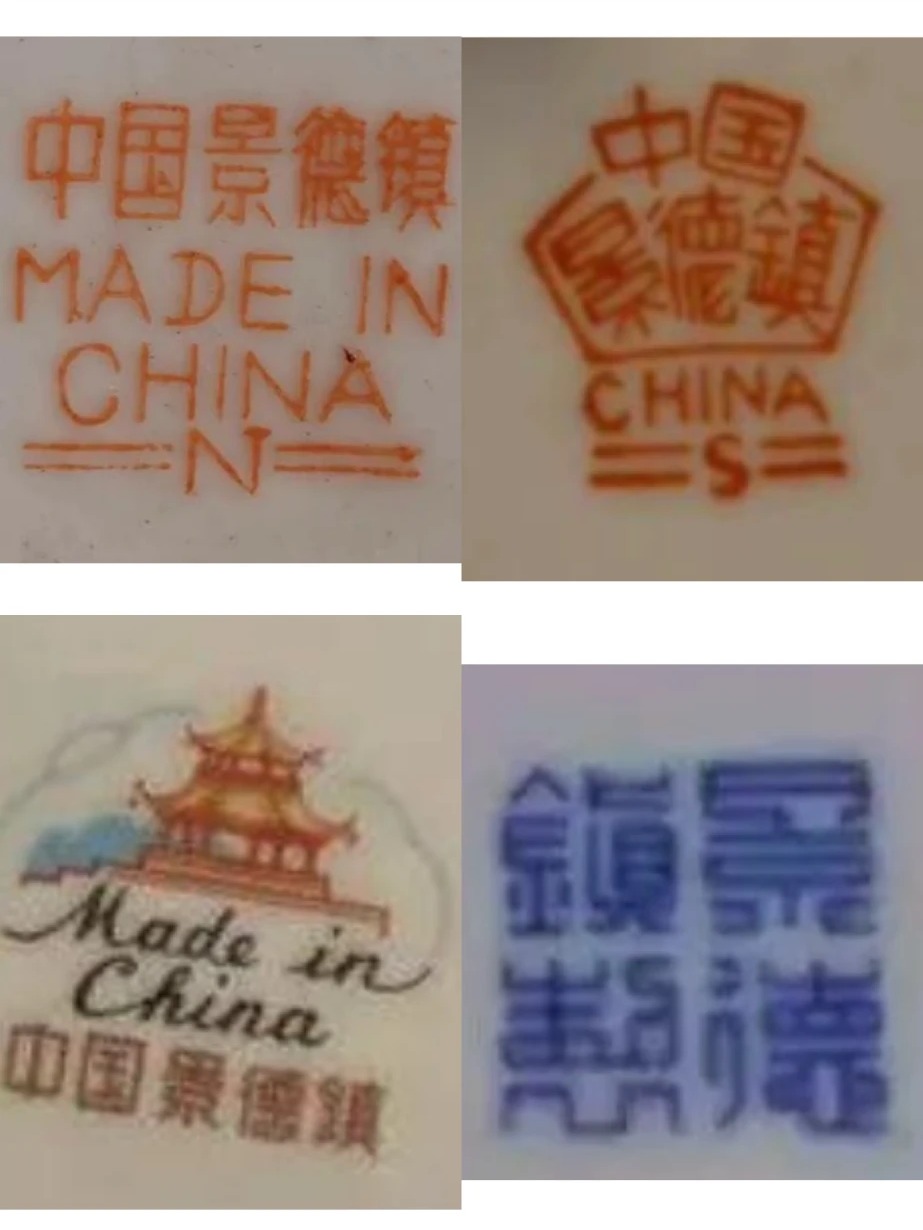
If you collect vintage pieces or find something in a second-hand shop abroad, you may see red marks reading 中国景德镇 (“China, Jingdezhen”) with “MADE IN CHINA” in English, often with a single letter or number underneath. These come from the state factory era. In the early 1950s the city’s many small workshops were merged into large state-run factories, and marks with factory codes came into use. Collectors date most of these marks roughly between the 1950s and the 1990s.
The exact meaning of each letter or number is debated among collectors, so treat any precise dating with caution. What these marks reliably tell you is that the piece is twentieth-century export ware, not an antique.
Reign Marks on New Porcelain
You will also see bowls and vases marked 大明宣德年制 (“made in the Xuande reign of the Great Ming”, 1426 to 1435) or 大清乾隆年制 (Qianlong, 1736 to 1795). In a tourist shop, these are almost always modern reproductions. Making copies of imperial porcelain is a real craft in Jingdezhen and there is nothing wrong with buying a good one. The problem only starts when someone tells you a new piece is old.
A rule of thumb from our price guide: if a stall is selling a “Ming dynasty” piece for a few hundred yuan, it is not Ming.
Why a Mark Alone Is Not Proof
Here is the uncomfortable part. Chinese media have reported for years that machine-made porcelain from other production centres is stamped with Jingdezhen-style marks and brought here to be sold as local work. Local sellers joke that it is like hairy crabs that take a quick bath in Yangcheng Lake and come out as famous Yangcheng crabs. A stamp costs very little. The difference in price between factory porcelain and handmade Jingdezhen work is large.
The new law makes copying the official 1004 seal risky, and that does help. But older, unregistered styles of mark are still easy to print. Treat any mark as the start of your check, not the end of it.
What Actually Tells You It Was Made Here
Local buyers look at three things together. None of them is perfect alone.
- The craft. Look at the foot ring (the unglazed ring the piece stands on). Hand-thrown and trimmed pieces show small tool marks and slight variation. Slip-cast factory pieces are perfectly even and often feel heavy for their size. Good Jingdezhen porcelain is usually thin, with a glaze that looks deep and smooth rather than plastic.
- The sound. Many locals tap a cup with a fingernail. Dense, well-fired porcelain gives a clear, ringing note. A dull sound can mean a crack or a lower firing. It is a useful habit, but it cannot tell you which town a piece came from.
- The seller. This is the one locals say matters most. A shop attached to its own kiln or studio, or a maker you meet at a weekend market, can tell you exactly where and how a piece was made. A shop that cannot answer that question is telling you something too.
Price is the last check. If handmade blue-and-white with a Jingdezhen mark costs the same as a supermarket mug, something does not add up.
Frequently Asked Questions
Is every piece with “Jingdezhen” on the bottom made in Jingdezhen?
No. Most are, but marks are cheap to copy and porcelain from other towns is sometimes stamped and sold here. The official 1004 “Made in Jingdezhen” seal is the most reliable mark because it is licensed and protected by law, but you should still look at the piece and ask the seller.
What does the number 1004 mean on Jingdezhen porcelain?
It is the year 1004, when the town was named after the Jingde reign of the Song dynasty. It appears on the city’s official regional brand seal, launched in 2022.
Is a piece without the 1004 seal fake?
No. The seal is new and only licensed companies use it. Many genuine local makers still use the older square seal, the handwritten 景德镇 mark or their own studio mark, and many artists’ pieces carry only a personal seal.
What is the difference between 景德镇制 and 景德镇彩?
制 means “made” and 彩 means “decorated”. 景德镇彩 only claims the painting or decoration was done in Jingdezhen. The porcelain body may come from elsewhere.
My piece has a Ming or Qing reign mark. Is it an antique?
Almost certainly not, if you bought it new in a shop. Jingdezhen makes a great many reproductions of imperial porcelain, complete with reign marks. For anything sold as an antique, ask for documented provenance or an independent appraisal before paying antique prices.
Keep Reading
- What to buy in Jingdezhen, and what it costs
- How Jingdezhen porcelain is made, step by step
- Shop with a local: our half-day porcelain buying tour
- Ordering porcelain from Jingdezhen from abroad
Have a Question About This Trip?
Send us a quick note and we will get back to you.