
Eight kilometers from Jingdezhen sits a government office that ran a county for over a thousand years — and looks almost exactly like it did when the last magistrate walked out the door.
The Best-Preserved County Government Hall in China
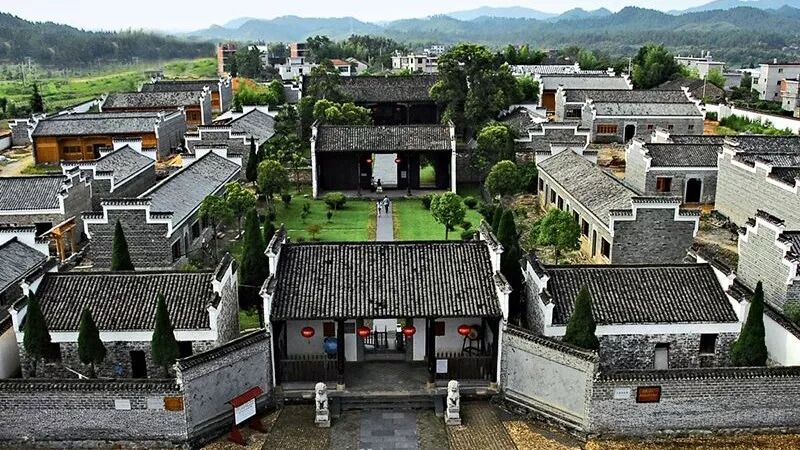
Most visitors come to Jingdezhen for porcelain and never make it out to Fuliang County, eight kilometers northeast of the city center. That’s a shame, because Fuliang Ancient County Yamen (浮梁古县衙) is one of the most complete pieces of pre-modern Chinese government architecture still standing anywhere in the country.
A yamen was a county’s administrative headquarters under imperial rule — courtroom, tax office, jail, and the magistrate’s residence, all under one roof. Most of them didn’t survive the 20th century intact. This one did, almost by accident.
Fuliang County was created in 742 AD, and in 816 AD its seat moved to what’s now called Jiucheng (“Old City”) Village — where it stayed for the next 1,100 years, until the county government relocated into Jingdezhen proper in 1916. Most of the buildings standing today date to 1665, with the main hall rebuilt in 1762 after a fire and last renovated in 1909. After 1916, the complex was used as a leftover government office, then a wartime middle school, then a school and a factory. That unglamorous afterlife is exactly what saved it — nobody tore it down to build something else.
In 1987 it was designated a Jiangxi Provincial Cultural Relic, and locals call it “the finest yamen south of the Yangtze” (江南第一衙). Having walked through a lot of reconstructed “ancient” sites in China, I can tell you the difference is obvious the moment you step through the gate here — this one is real.
A Walk Through the Complex
Everything here is laid out on a strict north-south line, the way Chinese government buildings were supposed to be. Guests often ask me why it feels so formal compared to a temple or a garden — it’s because every step of the walk was designed to remind visitors exactly where they stood in the hierarchy.
You start at the screen wall, painted with bats, lotus flowers, and ruyi clouds — “bat” is a pun on the word for good fortune in Chinese, and the whole design is a not-so-subtle reminder to the magistrate to govern honestly. Walk around it and you reach the front gate, which locals nickname the “figure-eight gate” because the paving stones, the wall, and the screen all fan out at matching angles.

Past the front gate is a second, ceremonial gate with three separate doors — the center door was for the magistrate and visiting officials only, the east door for ordinary staff, and the west door for prisoners. Nobody mixed up which door they used. Beyond it, a courtyard flanked by the six functional departments (personnel, revenue, rites, military affairs, punishment, and public works) leads to a nearly 100-meter stone walkway lined with old cypress trees and a well that’s as old as the buildings themselves.
That walkway ends at the main hall, also called Qinmin Tang (“Hall for the People”). It’s the largest structure in the complex, and it’s where the magistrate issued rulings, held ceremonies, and received imperial edicts. The plaque overhead reads “Bright Mirror on High” — a promise of impartial judgment — and behind the magistrate’s seat is a mural of the sun rising over ocean waves.

Behind the main hall, the architecture changes register entirely. The second hall (for civil disputes and receiving visiting officials) and third hall (the magistrate’s private office and residence) are built in a domestic Huizhou style — smaller, quieter courtyards instead of the main hall’s imposing scale. Further back still is a garden where the magistrate’s family relaxed, though the servants’ quarters that once stood alongside it are gone.
On display throughout are period objects — official robes, instruments of punishment, ceremonial weapons, and a sedan chair — which help the whole route feel lived-in rather than staged.
Carved in Stone: Fifty Couplets With Something to Say
What I like most about this place is easy to miss if you’re moving fast: the carved and painted couplets on the pillars and lintels throughout the complex, over fifty of them. They’re not decoration. They’re pointed messages to whoever held office here.
At the front gate: “Governing Fuliang, one pillar holds up the sky; loving its people, ten years must plant firm roots” — a reminder that a magistrate’s term (up to ten years across renewals) is a heavy, temporary responsibility. At the third hall: “Gaining a post brings no glory, losing one no shame; don’t say an official is useless — a place depends entirely on its official. Eating the people’s rice, wearing the people’s cloth; don’t think the people can be deceived — you were one of them yourself.” Blunt, for a building full of officials.
In recent years the site has leaned into this angle, building out an “honest governance culture” exhibit across the complex’s east, central, and west sections — covering historical inspection systems, incorruptible officials from Fuliang’s past, and the couplets themselves. If you read Chinese, budget extra time; if you don’t, ask your guide to translate a few. They’re worth it.
Why Fuliang Outranked Ordinary Counties
Here’s the detail that surprises most visitors: Fuliang was never an ordinary county. Most county magistrates in Ming and Qing China held the 7th official rank. Fuliang’s magistrate held the 5th — a distinction shared by almost no other county in the empire, and one still reflected in the yamen’s unusually grand scale.
The reason was money. Fuliang’s economy ran on two industries at once: tea and porcelain. “Villagers picked leaves for tea, shaped clay into wares” is how a period text put it, and an even older source — the Dunhuang manuscripts — records that “the world came seeking Fuliang and Shezhou tea.” Jingdezhen’s kilns and Fuliang’s tea gardens (you can still visit one of the villages behind that trade at Yantai Village, about 40 minutes from here) generated enough tax revenue that the imperial court upgraded the county’s official standing to match. Fuliang went from a standard county in the Tang dynasty to a “notable county” in the Song, and a full-fledged “department” (州) in the Yuan.
It’s a useful piece of context for the whole region: Jingdezhen didn’t build its wealth on porcelain alone. Tea and porcelain grew up together here, and this building is the clearest physical proof of how much that mattered to the people who governed it.
The Red Pagoda
Directly in front of the yamen stands the Red Pagoda (红塔), built in the early Northern Song dynasty — over a thousand years old, and one of the most completely preserved large pagodas anywhere in Jiangxi Province. It’s seven stories, 37.8 meters tall, built entirely from brick, with projecting brick platforms at each level instead of railings. It was renovated once, in 1575, and has needed little intervention since. A temple that once stood beside it — West Pagoda Temple — is long gone, but the pagoda itself was designated a Jiangxi Provincial Cultural Relic in 1959, decades before the yamen received the same status.
“West Pagoda at Sunset” was a celebrated scene along the old Chang River long before this was a tourist site, and it’s easy to see why — the brick catches the evening light in a way that photographs badly undersell.

Together, the yamen, the pagoda, and the surrounding “honest governance” cultural park make up the Fuliang Ancient Yamen Scenic Area, rated a National 4A attraction since 2005.
Good to Know
¥45 for admission, and unlike the ceramic museums in town, this one doesn’t need advance booking through an app — it isn’t a high-traffic site, so you can just show up. Tickets are checked at the gate and are valid same-day only, so don’t buy ahead if your plans might shift.
Opening hours run seasonally: 8:10 AM – 6:00 PM in spring and summer (last entry 5:30 PM), and 8:10 AM – 5:30 PM in autumn and winter (last entry 5:00 PM).
Getting there: it’s about 8 kilometers from central Jingdezhen. There’s no direct public transit route that makes sense for a short visit, so I’d just book a taxi or car there and back — it’s a quick trip and not worth the hassle of transfers.
Children 6 and under (or under 1.2m tall) and seniors 65+ get free admission, along with several military and veteran categories.
Pair it with: if you’re already heading out to Fuliang County, Yantai Village is about 40 minutes further on and covers the tea side of Fuliang’s history — a 2,000-year-old tea village with its own historic lanes and architecture. Doing both in one day makes for a full, worthwhile trip outside the city.
Want this built into a custom day trip around your dates? Get in touch and I’ll work it into your itinerary.
Have a Question About This Trip?
Send us a quick note and we will get back to you.