
Eugene came to Jingdezhen with three things on his list. Make something with his own hands. Bring home some Ru ware for his mother, who loves that soft sky-blue glaze. And see the Imperial Kiln Museum properly, with someone who could answer his questions about Ming history.
He had a day and a half. Willow, my wife and co-guide, planned it around him and spent it with him. I was away in another province that week, so this is their trip as Willow told it to me, in her messages and a long phone call that night.
Quick facts
- Who: Eugene, a solo traveller from the US who speaks good Chinese and wanted to use it.
- When: November 10 to 11, 2026. From the afternoon of day one to his 2:31 pm train on day two.
- Route: Pottery studio in Sanbao, Ru ware shopping, the Imperial Kiln Museum at night, the China Ceramics Museum, the Ancient Kiln.
- Included: Willow as private guide and translator, hotel meeting, all museum tickets and timed-entry bookings, the pottery studio fee, and firing and shipping follow-up for his piece.
- Plan your own: See the custom itinerary or the full-day guided experience.
The itinerary at a glance
| When | Where | What |
|---|---|---|
| Day 1, afternoon | Pottery studio, Sanbao | Wheel throwing and painting his own bowl |
| Day 1, early evening | Ceramics shops in town | Choosing Ru ware for his mother |
| Day 1, evening | Imperial Kiln Museum, Taoyangli | Night visit, Ming imperial porcelain |
| Day 2, morning | China Ceramics Museum | A thousand years of Jingdezhen porcelain |
| Day 2, late morning | Ancient Kiln Folk Customs Museum | Old workshops, the kiln god, the singing bowls |
| Day 2, 2:31 pm | Jingdezhen North Station | Train out |
A pottery class in Chinese, with English on standby
Willow met Eugene at the Taoxichuan Hotel and they went straight to a pottery studio in Sanbao, the quiet valley of workshops just outside the city.
Eugene’s Chinese is good, and he wanted to practise it all day. So the teacher spoke Chinese, slowly, and Eugene followed. When a word got away from him, he turned to Willow and she gave him the exact English. The teacher told him to keep his hands 稳定, wěndìng. “Stable?” he asked. “Steady,” Willow said, and his hands settled.
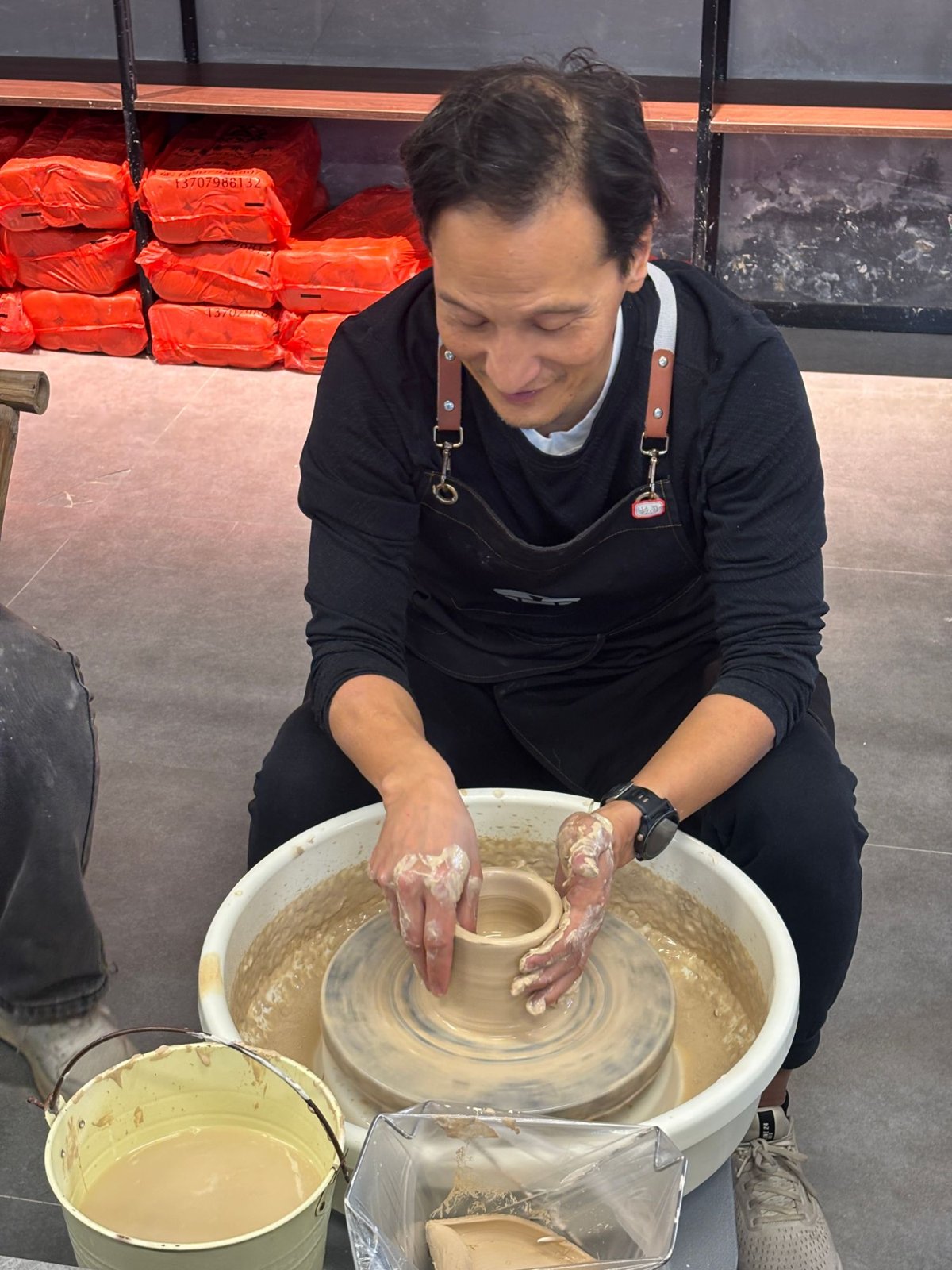
That’s the kind of help that matters in a pottery class. Not a translation app held up between you and the teacher, but someone next to you who knows the craft words in both languages and steps in only when you need it.
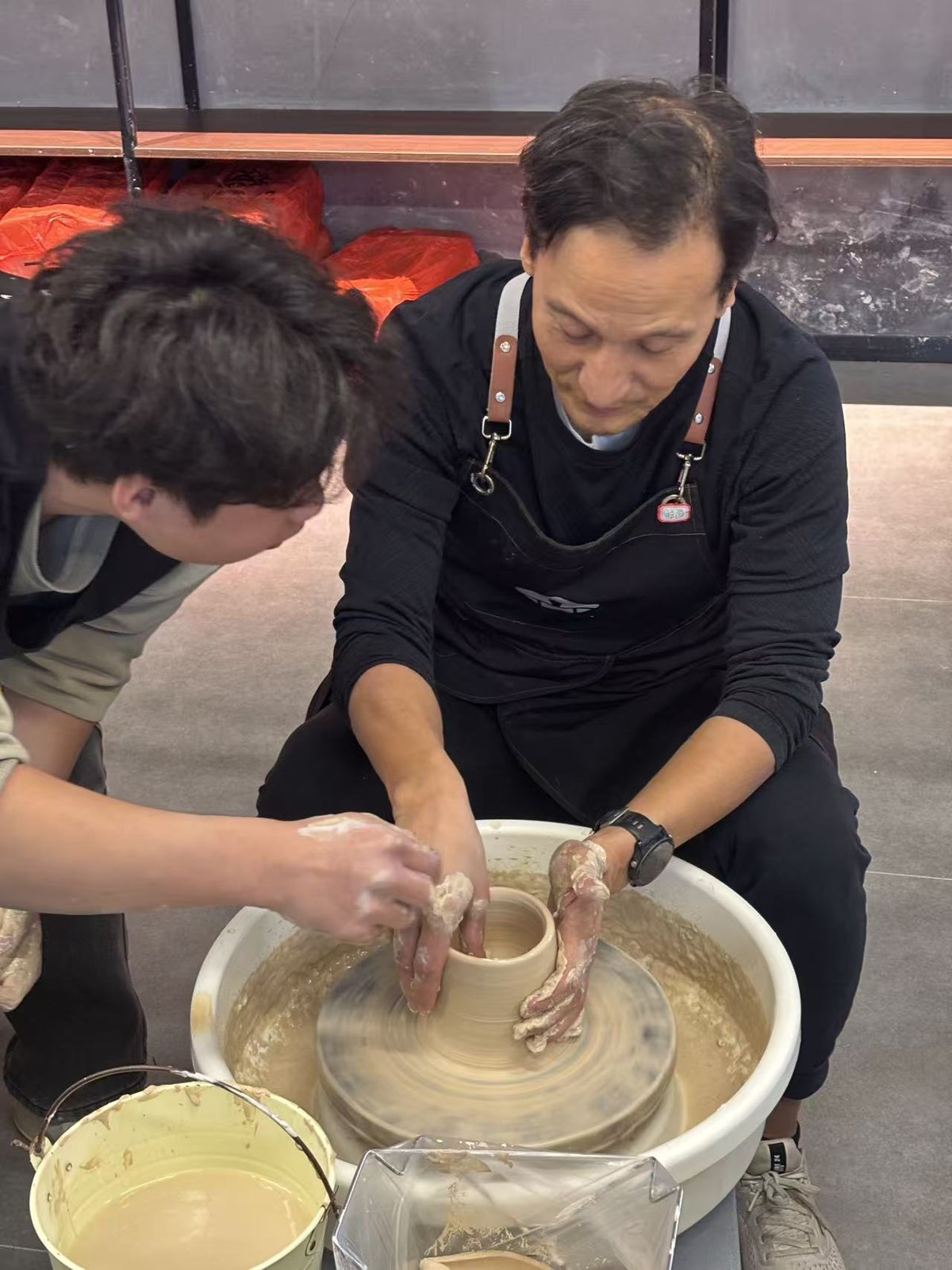
沈以宁: a name on the bottom of the bowl
After throwing comes painting, and before a piece goes to the kiln, you sign the bottom. Eugene wrote 沈, his surname, Shen. Then he decided to write his full Chinese name: 沈以宁, Shěn Yǐníng. 宁 means peace and calm. Everyone at the table said what a lovely name it was. “Thank you,” he said. “I think so too.”

Willow wrote the name out for him with a brush in traditional characters, so he could see it in full. Then they swapped. Her Chinese name is 温惠, Wēn Huì: 温 means warm, 惠 means kind and wise. Eugene said that sounded exactly like her.
A Chinese song they both knew by heart
While they painted, a Hua Chenyu song came on the studio radio. Eugene asked if Willow listened to Chinese pop. He does, a lot. It’s how he keeps his Chinese sharp, along with Chinese TV dramas. He told her she had to watch 大生意人. She recommended Empresses in the Palace (甄嬛传) in return, and the studio staff burst out laughing.
Then she asked who else he listened to. “Mayuan,” he said. “Mayuan Poets?” “Yeah, yeah, yeah.” And at the same moment they both said the song: Lugu Lake (泸沽湖). He started singing, Willow joined in, and they sang the chorus together over a table of half-painted bowls.
Choosing Ru ware for his mother
Ru ware is the Song dynasty glaze Chinese collectors still prize above almost any other: a quiet blue-green, like the sky after rain, often with fine crackle. Jingdezhen makes a lot of Ru-style pieces today, and the range is huge, from simple everyday cups to careful copies of museum pieces.
Willow told Eugene at the start that shopping was completely optional. They could just look, and he’d come away understanding the glaze better either way. He wanted to look. So she took him to three shops at three different levels, from a fine reproduction of a piece in the British Museum to plain, unpainted cups made for everyday use, and let him see and hold the difference.
He chose a set of five simple sky-blue cups for his mother. Clean shape, no painting, just the glaze. He said it was exactly what she’d like. Then, with the evening getting on, they took a taxi to the museum.
The Imperial Kiln Museum at night
The Imperial Kiln Museum stands on the site of the Ming and Qing imperial kilns, where porcelain was made only for the emperor. It’s open in the evening, and that’s the best time to go: the long brick vaults are lit, the crowds are gone, and the excavated kiln sites around it are quiet.
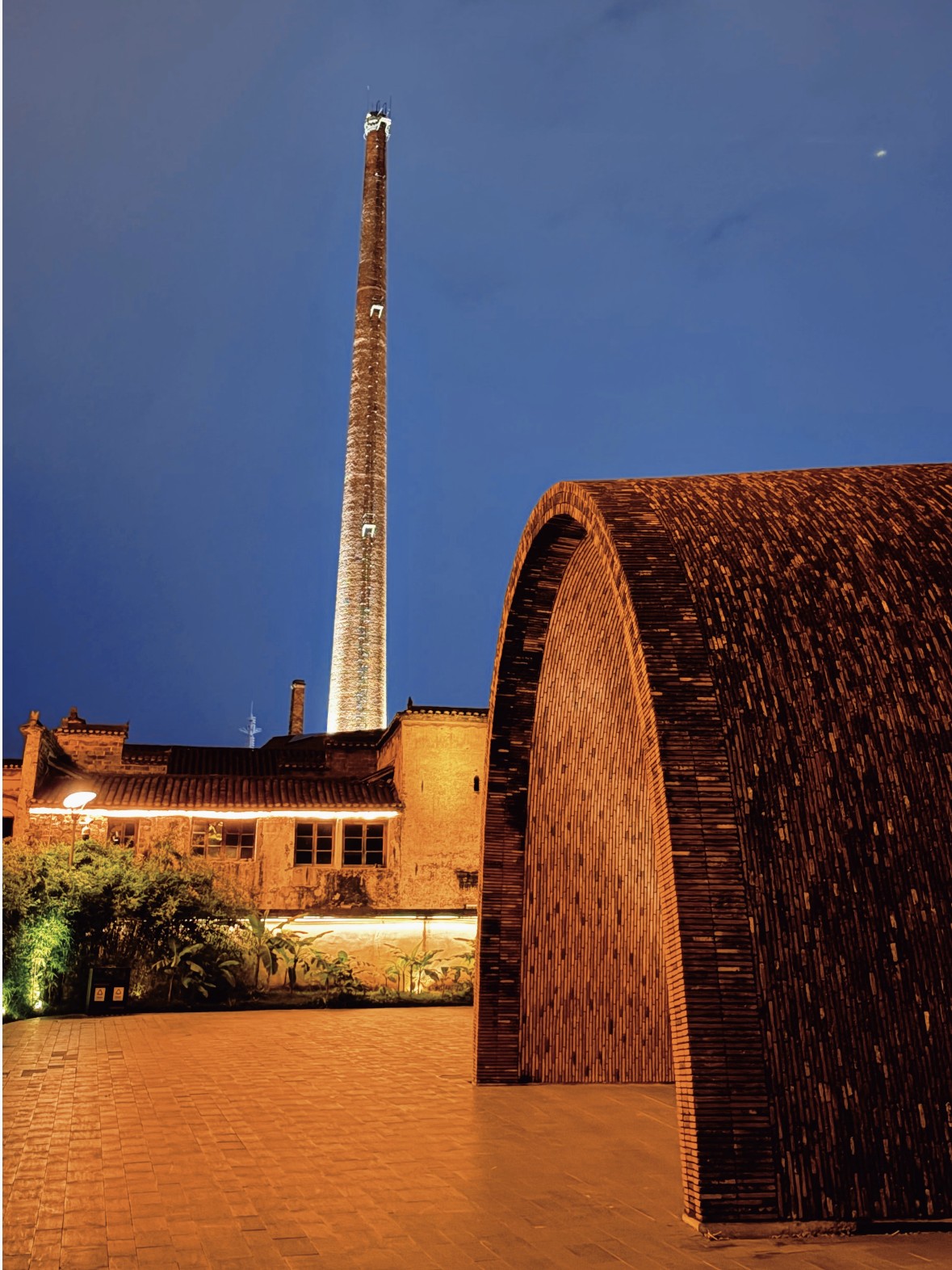
One practical note if you go: the museum sits inside the Taoyangli scenic area, its vaulted buildings look very alike, and each gate leads to a different route. Coming in from one side takes you past the Longzhu Pavilion, the old imperial supervisor’s tower. From another side you reach the galleries directly. Decide which you want before you arrive, or go with someone who knows the site.
Searching the galleries for the Hongzhi emperor
Eugene knows his Ming history. In front of the reign marks he talked about the Zhengtong emperor, who led his own army against the Mongols, was captured, and years later took his throne back under a new reign name, Tianshun. Same man, two reign names.
His favourite emperor is Hongzhi. Hongzhi didn’t go to war, he explained, so fewer people died and ordinary people lived better. That’s what a good ruler looks like to him. So he and Willow made a game of it: find the Hongzhi porcelain. Not Yongle, not Jingtai, not Qianlong. They found it at the entrance to one of the smaller side galleries, including the yellow glaze his reign is famous for.
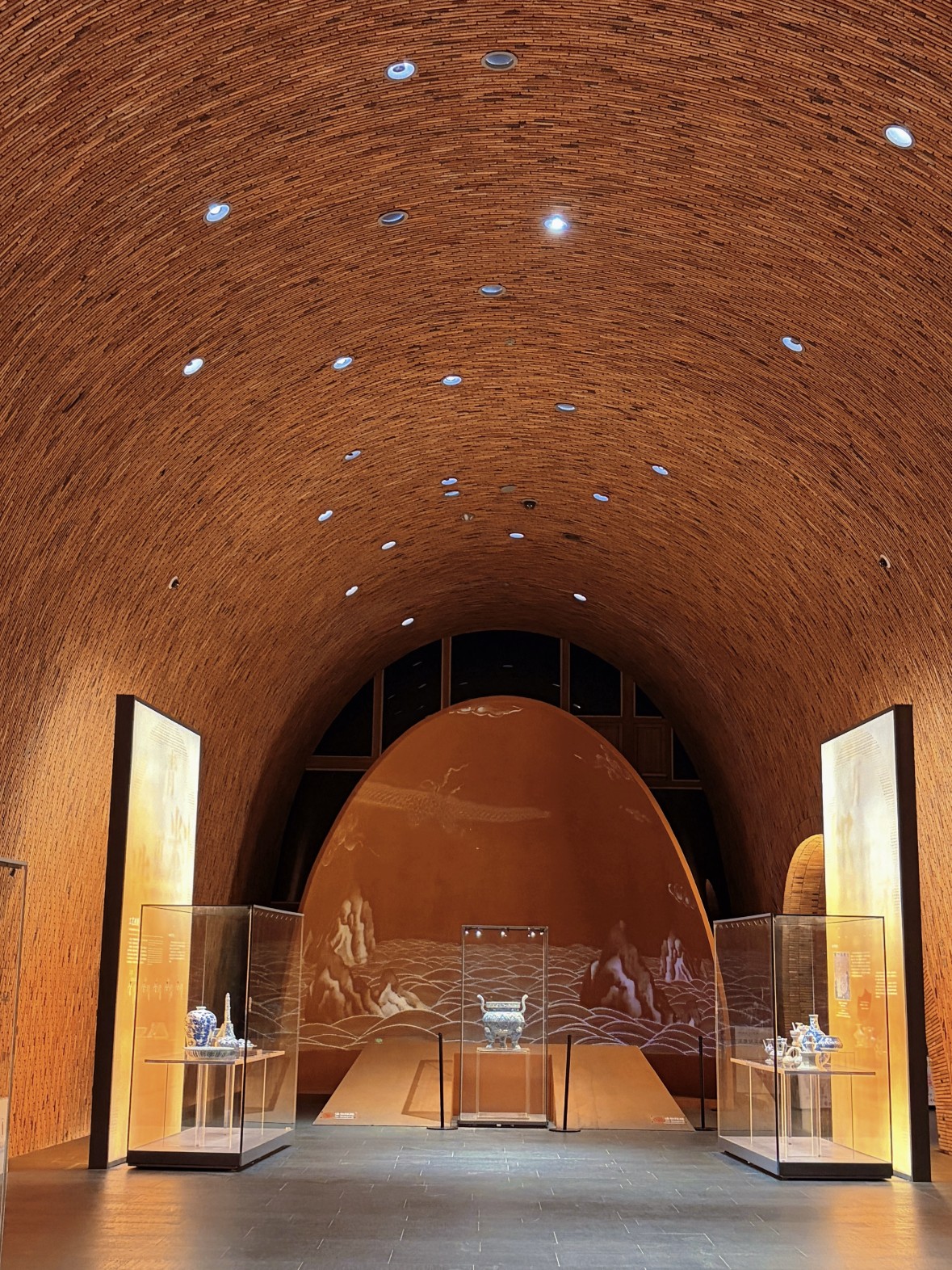
Seeing pieces marked Yongle, Eugene asked whether the emperor himself had used them. Willow explained that the imperial kiln made porcelain for the court, so these were made for the Yongle emperor’s palace. In a side gallery they found a porcelain pillow. Eugene guessed it from the shape, and he was right: people really did sleep on them, especially in summer, because porcelain stays cool. Next to it stood a porcelain drum stool. “That looks so hard,” he said. It’s a seat, and yes, it is.
Back home, Eugene studies Chinese with a teacher from Guangdong. On top of her homework, he sets his own: he turns the Chinese history he’s been reading into a slide presentation and gives it to her. Willow told me he’s the most curious guest she’s had.
They finished around ten. Before they said goodnight he asked about the plan for the next day, and said, “See you tomorrow.”
Day two: the China Ceramics Museum and the Ancient Kiln
That night Willow went through the history of the next two museums again, because she knew Eugene would come with questions. They met at nine and started at the China Ceramics Museum, which walks you through a thousand years of Jingdezhen porcelain in one building.

Then the Ancient Kiln Folk Customs Museum, a village of old workshops and wood-fired kilns. In one workshop there’s a table of “old tea-flower” bowls, each holding a little water. Wet your palm, rub it across the rim in a steady rhythm, and the bowl starts to hum. Willow had Eugene try. A couple of goes, and it sang.
Eugene knows what he likes. Ru’s quiet celadon spoke to him more than the famous blue-and-white, and that was fine. Nobody tried to change his mind or sell him anything. For two days he didn’t have to think about where to go, how to book, how to pay or what to say. If he wanted something, Willow helped him find the right piece. If he didn’t, they moved on to the next thing he cared about.
“I’m glad I met you”
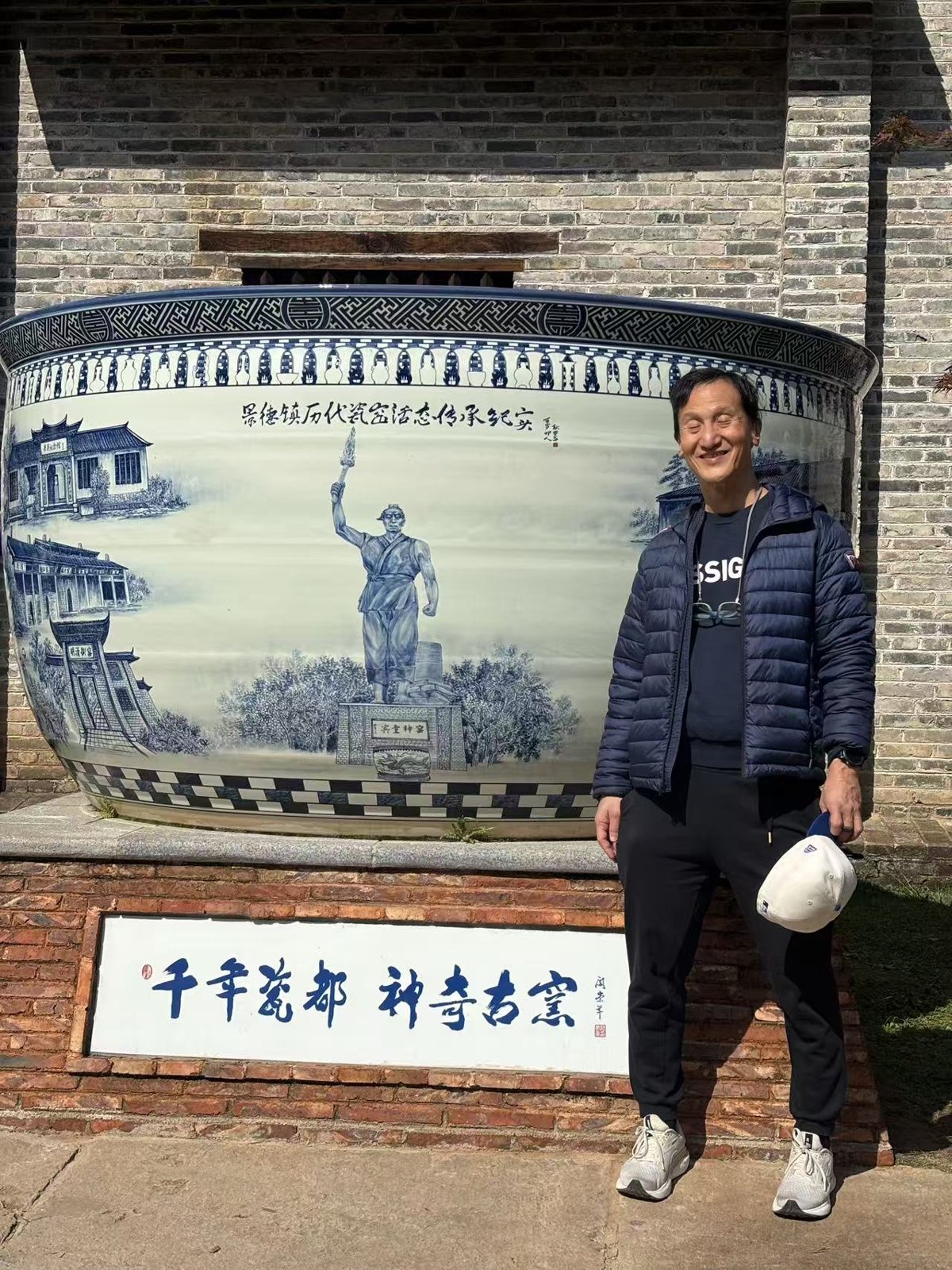
Before he left for his train, Eugene asked Willow for a photo together. He told her she was a very good person, that he was glad to have met her, and that he really likes Jingdezhen. He asked when I’d be back, so he could meet me next time. And he’s going to ask his wife and kids if they want to come with him.

What we handled behind the scenes
- Every booking. The Imperial Kiln Museum and the China Ceramics Museum both need timed-entry reservations through a Chinese mini-program. We made them, including the evening slot.
- Chinese when he wanted it, English when he needed it. Eugene practised his Chinese all day. Willow stepped in only when a word got stuck.
- Homework on the museums. A curious guest gets a prepared guide. Willow read up on each site the night before.
- Shopping without pressure. Shops at different levels so he could compare. Buying was always optional.
- His bowl. Firing, collecting and shipping the piece signed 沈以宁 is our job now, not his.
FAQ
Can I see Jingdezhen in a day and a half?
Yes, if it’s planned well. Eugene’s route covered a pottery class, Ru ware shopping, the Imperial Kiln Museum at night, the China Ceramics Museum and the Ancient Kiln, with a train out at 2:31 pm on day two. The trick is the evening museum slot, which frees up the next morning. We can build a custom itinerary around your train times.
Where can I buy Ru ware in Jingdezhen?
Many ceramics shops in Jingdezhen sell modern Ru-style pieces, and quality and price vary a lot, from simple everyday cups to fine reproductions of museum pieces. These are new pieces made in Jingdezhen, not antiques. Tell us your budget and what it’s for, and we’ll take you to shops that fit. Our porcelain buying guide has more.
Can I visit the Imperial Kiln Museum in the evening?
Yes. It has evening entry slots and is beautiful lit up at night. You must book a time slot in advance through the Changyou Jingdezhen mini-program, and the museum is inside the Taoyangli scenic area. Here’s how to book the Imperial Kiln Museum.
What is special about Hongzhi porcelain?
The Hongzhi emperor (reigned 1488 to 1505) is remembered as one of the gentlest Ming rulers. Porcelain from his reign is best known for its yellow glaze, often called “delicate yellow” (娇黄), which many collectors consider the finest yellow of the Ming dynasty.
Are the Zhengtong and Tianshun emperors the same person?
Yes. Both are reign names of Zhu Qizhen, the Ming emperor Yingzong. He was captured by the Oirat Mongols at the Battle of Tumu in 1449, while his brother ruled as the Jingtai emperor. He was later released and took the throne back in 1457, reigning as Tianshun.
I speak some Chinese. Do I still need a guide?
Maybe not a translator, but a local guide still saves you a lot. Museum bookings run through Chinese apps, craft words are hard even for good speakers, and it helps to have someone who knows which shops fit your budget. If you want to practise your Chinese, we’ll happily speak it with you all day.
Want a day and a half like this?
Tell us your dates, your train times, what you want to see and what you’d like to bring home. We’ll book the museums and plan the rest around you.
Have a Question About This Trip?
Send us a quick note and we will get back to you.